
9709 Past Papers: Complete A Level Mathematics Preparation Guide
Preparing for Cambridge International AS & A Level Mathematics can feel challenging, especially when you have to understand different mathematical concepts, solve complex problems and manage your time during examinations. However, with the right preparation strategy, you can make your revision more organised and improve your confidence.
9709 Past Papers are valuable study resources for students who want to understand the Cambridge Mathematics examination format and practise questions based on the syllabus. They allow you to test your knowledge, identify topics that need more attention and become familiar with the way examination questions are presented.
Whether you are preparing for AS Level or completing your full A Level Mathematics course, this guide explains the 9709 syllabus, examination papers, mark schemes and practical revision strategies to help you prepare more effectively.
Table of Contents
1. What Is Cambridge Mathematics 9709?
Cambridge International AS & A Level Mathematics (9709) is an internationally recognised mathematics qualification offered by Cambridge International Education. It helps students develop mathematical knowledge, logical thinking, problem-solving abilities and the confidence to apply mathematical methods to different situations.
The subject covers several areas of mathematics, including Pure Mathematics, Mechanics and Probability & Statistics.
Students can follow different examination routes depending on whether they are studying AS Level or the complete A Level qualification.
For the 2026–2027 examination period, Cambridge provides an updated syllabus that explains the subject content, assessment structure and examination requirements.
You can check the official syllabus here:
https://www.cambridgeinternational.org/Images/697368-2026-2027-syllabus.pdf
2. Understanding the 9709 Examination Papers
Before downloading and practising 9709 Past Papers, students should understand the different examination components.
Cambridge Mathematics 9709 has six examination components.
| Paper | Component | Main Topics |
|---|---|---|
| Paper 1 | Pure Mathematics 1 | Algebra, functions, trigonometry, differentiation and integration |
| Paper 2 | Pure Mathematics 2 | Advanced algebra, logarithms, differentiation and integration |
| Paper 3 | Pure Mathematics 3 | Advanced calculus, vectors, complex numbers and differential equations |
| Paper 4 | Mechanics | Forces, motion, momentum, energy and power |
| Paper 5 | Probability & Statistics 1 | Probability, data, distributions and statistics |
| Paper 6 | Probability & Statistics 2 | Poisson distribution, hypothesis testing and statistical methods |
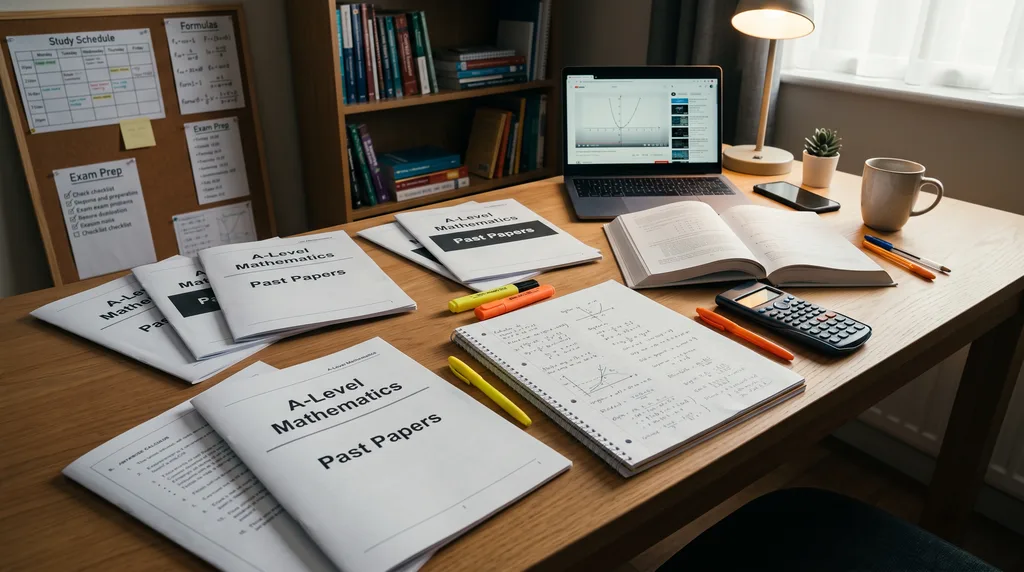
Which papers should you imprepare for?
Your examination route depends on your qualification.
For AS Level Mathematics:
Students take two components through one of the available routes. These include Pure Mathematics 1 with Pure Mathematics 2, or Pure Mathematics 1 with Mechanics or Probability & Statistics 1.
For full A Level Mathematics:
Students take four components. Their route includes Pure Mathematics 1 and Pure Mathematics 3, alongside the relevant applied mathematics components.
An important point is that Paper 2 and Paper 3 are alternative routes. Students cannot take both in the same examination series.
Always check your school’s examination entry and the latest Cambridge syllabus before selecting papers for revision.
3. Why Are Past Papers Important for A Level Mathematics?
Understanding mathematical formulas is important, but knowing how to apply them in examination questions is equally necessary.
This is where 9709 Past Papers become useful.
Here are some important benefits of regular past-paper practice.
A Level Mathematics Past Papers: Exam Preparation GuideA Level Mathematics Past Papers: Exam Preparation Guide
Understand the Examination Pattern
Past papers help you become familiar with question formats, mathematical notation, instructions and the level of difficulty expected in examinations.
You can also understand how questions are divided into different parts and how mathematical methods are applied.
Improve Problem-Solving Skills
Mathematics requires more than memorising formulas. Students need to understand which method to use and how to reach the correct answer.
Regular practice helps you develop this ability and approach unfamiliar questions with greater confidence.
Identify Weak Topics
Sometimes students feel confident about a topic until they attempt examination questions.
For example, you might understand differentiation but struggle when a question combines differentiation with coordinate geometry.
Practising previous examination questions helps identify these weaknesses so you can improve them before the actual examination.
Develop Time Management
Completing a paper within the examination time requires planning and practice.
When you solve papers under timed conditions, you learn how to divide your time between questions and avoid spending too long on a single problem.
Build Examination Confidence
The more familiar you become with examination-style questions, the more comfortable you may feel when facing your actual examination.
4. Where Can You Find 9709 Past Papers?
Students can find Cambridge Mathematics practice resources through official syllabus materials and established educational resources.
Here are some useful places to start.
Cambridge International
The official Cambridge website provides syllabus documents, examination information and specimen materials.
Visit:
Students should use the latest syllabus to make sure their preparation matches their examination year.
PapaCambridge
PapaCambridge provides a collection of Cambridge examination resources, including Mathematics 9709 question papers, mark schemes and other revision materials.
Visit:
https://pastpapers.papacambridge.com/papers/cie/as-and-a-level-mathematics-9709
You can explore available examination sessions and select the paper you need.
Please remember that PapaCambridge is an independent educational resource, not the official Cambridge examination website.
Other Revision Resources
Students can also use their school-provided resources, teacher recommendations, textbooks and topic-based worksheets to strengthen their understanding.
Always check that the material matches your current syllabus.
5. How to Use Past Papers Effectively
Simply downloading papers is not enough. You need a proper practice routine to get meaningful results.
Follow these steps to make your revision more effective.
Step 1: Understand the Syllabus First
Before attempting a complete examination paper, review the topics included in your selected component.
Make a list of the topics you understand well and those that need additional practice.
This will help you organise your revision.
Step 2: Start With Topic-Based Questions
If you are struggling with a particular topic, begin with questions related to that topic.
For example, if differentiation is difficult, practise differentiation questions before attempting a complete Paper 1.
This approach helps you build confidence gradually.
Step 3: Solve Complete Papers Under Timed Conditions
Once you have covered the relevant topics, attempt a complete paper.
Choose an appropriate examination session and try to follow the actual examination conditions.
Avoid checking your notes or looking at solutions while attempting the paper.
Step 4: Check Your Answers Using Mark Schemes
After completing your paper, compare your answers with the official mark scheme where available.
Do not only check whether your final answer is correct. Review the mathematical steps and understand where you lost marks.
Step 5: Maintain a Mistake Notebook
Write down the questions you answered incorrectly and the reason behind each mistake.
Your notes might include:
- Incorrect formula selection.
- Calculation errors.
- Missing mathematical steps.
- Misunderstanding the question.
- Running out of examination time.
Review these mistakes regularly and attempt similar questions again.
Step 6: Repeat the Process
Practise different examination sessions and monitor your progress.
Your aim should be to improve your understanding and accuracy rather than simply completing a large number of papers.
6. Understanding Mark Schemes
Mark schemes are an important part of A Level Mathematics preparation.
They explain how marks are awarded for different stages of a solution. This is particularly useful when a question requires several mathematical steps.
For example, a differentiation question may award marks for:
- Applying the correct differentiation rule.
- Obtaining the correct derivative.
- Substituting the given value.
- Reaching the required final answer.
A student might make a small calculation mistake but still receive marks for correct mathematical working, depending on the marking instructions.
That is why you should always show your working clearly instead of writing only the final answer.
Tip: After checking your answers, try solving incorrect questions again without looking at the mark scheme.
This will help you understand the method rather than simply memorising the solution.
7. Important Topics to Practise for Mathematics 9709
Your revision plan should follow the component you are studying.
Here are some important syllabus areas to include.
Pure Mathematics
For Paper 1 and the advanced Pure Mathematics papers, students should practise:
- Quadratic equations and functions.
- Coordinate geometry.
- Circular measure.
- Trigonometry.
- Sequences and series.
- Differentiation.
- Integration.
- Logarithmic and exponential functions.
- Vectors and complex numbers, where included in the selected component.
Mechanics
For Paper 4, focus on:
- Forces and equilibrium.
- Kinematics of motion in a straight line.
- Momentum.
- Newton’s laws of motion.
- Energy, work and power.
Probability & Statistics
For Paper 5 and Paper 6, practise:
- Representation of data.
- Permutations and combinations.
- Probability.
- Discrete random variables.
- Normal distribution.
- Poisson distribution.
- Sampling and estimation.
- Hypothesis testing.
Remember that not every topic belongs to every paper. Check the current syllabus before planning your revision.
8. Common Mistakes Students Should Avoid
Even students who understand mathematical concepts can lose marks because of avoidable mistakes.
Here are some common problems to watch out for.
1. Practising Without Understanding
Memorising solutions does not guarantee that you can solve a different question using the same concept. Understand the method before moving to another topic.
2. Ignoring the Mark Scheme
Completing a paper without reviewing your mistakes means missing an important learning opportunity.
3. Skipping Difficult Questions
Avoiding difficult topics may create problems during the examination. Give additional time to the areas where you need improvement.
4. Not Managing Examination Time
Spending too much time on one question can leave insufficient time for the remaining questions.
5. Using Outdated Syllabus Materials
Older papers can still provide useful practice, but their questions may not always match the current syllabus. Check the syllabus before relying on older resources.
9. Frequently Asked Questions
What is Mathematics 9709?
Mathematics 9709 is the Cambridge International AS & A Level Mathematics subject code. It includes Pure Mathematics, Mechanics and Probability & Statistics components.
Where can I download 9709 Past Papers?
You can explore Cambridge International’s official subject resources and independent educational websites such as PapaCambridge for available question papers and mark schemes.
Are 9709 Past Papers useful for AS Level students?
Yes. They help AS Level students understand examination-style questions, practise mathematical methods and become familiar with the assessment structure.
Should I solve past papers with mark schemes?
Yes. Attempt the questions independently first, then use the mark scheme to check your answers and understand how marks are awarded.
How many years of past papers should I practise?
There is no fixed number that works for every student. Start with recent papers that match your current syllabus and gradually practise additional sessions as your understanding improves.
Can old Mathematics 9709 papers still help with preparation?
Yes. Older papers can provide additional practice, but always check the syllabus and avoid relying on questions from topics that are no longer included in your examination.
10. Final Thoughts
Preparing for Cambridge A Level Mathematics requires consistency, patience and a clear understanding of the syllabus. Reading textbooks and learning formulas are important, but applying mathematical knowledge through examination-style questions is equally valuable.
Make 9709 Past Papers a regular part of your revision routine. Practise different topics, review your mistakes, understand mark schemes and gradually improve your examination technique.
Remember, successful preparation is not about completing the highest number of papers. It is about understanding your mistakes and learning how to solve problems more effectively.
At Khadija Online Academy, our aim is to support students with structured learning, subject guidance and effective preparation strategies so they can approach their Cambridge examinations with greater confidence.