
A Level Mathematics Past Papers: How to Prepare for Exams
Preparing for Cambridge A Level Mathematics can feel challenging, especially when you need to understand complex concepts, solve unfamiliar questions, and complete examinations within a limited time. The right preparation strategy can make these challenges easier to manage.
A Level Mathematics past papers are valuable study resources because they allow students to practise exam-style questions, review mathematical methods, identify weaknesses, and build confidence before the examination.
However, simply downloading papers and solving questions randomly is not enough. You need a structured revision plan, a clear understanding of your syllabus, and regular practice with mark schemes.
In this guide, you will learn how to use past papers effectively, organise your revision, improve your problem-solving skills, and prepare for Cambridge examinations with greater confidence.
Table of Contents
Why Are A Level Mathematics Past Papers Important?
Mathematics requires more than memorising formulas. Students must understand concepts, select appropriate methods, show their working, and reach accurate answers.
Practising A Level Mathematics past papers helps you develop these skills through exam-style questions.
Here are some important benefits.
1. Understand the Exam Question Style
Past papers introduce you to the wording, structure, and difficulty of examination questions. You learn how mathematical problems are presented and what information you need to identify before starting a solution.
For example, a question might ask you to differentiate a function, calculate a stationary point, or explain a mathematical result. Regular practice helps you recognise which methods may be appropriate.
2. Identify Your Weak Topics
You may understand differentiation but struggle with integration, functions, trigonometry, mechanics, or probability and statistics.
When you practise A Level Mathematics past papers, record the topics where you make mistakes. This helps you focus your revision on areas that need more attention instead of repeatedly studying topics you already understand.
3. Improve Time Management
Completing questions accurately is important, but you must also finish the examination within the allocated time.
Timed practice helps you learn how to distribute your time, avoid spending too long on one difficult question, and return to unanswered questions when appropriate.
4. Learn How Marks Are Awarded
Mark schemes help you understand the expected mathematical methods and final answers. They can also show why a correct method, intermediate result, or clearly presented working matters.
Reviewing mark schemes after attempting A Level Mathematics past papers helps you recognise errors that may otherwise become repeated habits.
Step 1: Understand Your Cambridge Mathematics Syllabus
Before beginning your revision, identify your qualification, syllabus year, and examination components.
Cambridge International AS & A Level Mathematics is commonly identified by syllabus code 9709. The course includes Pure Mathematics and may include Mechanics and/or Probability and Statistics, depending on the route selected.
You should check your own syllabus rather than assuming that every student takes the same combination of papers.
Visit the official Cambridge International A Level Mathematics 9709 page to review the syllabus and available examination resources.
Create a topic checklist and mark each topic as:
- Strong: You can solve questions independently.
- Developing: You understand the method but sometimes make mistakes.
- Needs revision: You struggle to select or apply the correct method.
This simple system helps you organise your study time more effectively.
Step 2: Find Reliable A Level Mathematics Past Papers
Use trusted resources to obtain question papers, mark schemes, and specimen papers.
The official Cambridge International Mathematics 9709 past papers page is a useful starting point.
When selecting a paper, check the following details:
- Syllabus code: Make sure the paper is relevant to 9709.
- Examination series: Identify the relevant examination session and year.
- Paper number: Select the component that matches your course.
- Syllabus compatibility: Check whether the paper matches the syllabus you are studying.
- Mark scheme: Download the corresponding mark scheme when available.
Older papers can still provide useful practice, but their content may not fully match your current syllabus. Cambridge also notes that published past papers may not reflect the current syllabus, so check the latest syllabus before relying on older materials.
Differentiation in A Level Mathematics: If any thing you need to study you click here to more
If you have just started preparing, avoid attempting complete examination papers before you understand the main concepts.
Begin with topic-based revision. Review your notes, practise basic examples, and then progress to more challenging questions.
For example, when revising differentiation, make sure you understand the power rule, gradients, stationary points, and other methods required by your syllabus.
Once you feel confident, try relevant examination questions without looking at the solutions.
You can also read our related guide on Differentiation in A Level Mathematics: Rules, Formulas and Solved Examples to revise important differentiation methods before attempting questions on this topic.
Use the same approach for integration, functions, trigonometry, and any applied mathematics topics included in your course.
Step 4: Practise Under Exam Conditions
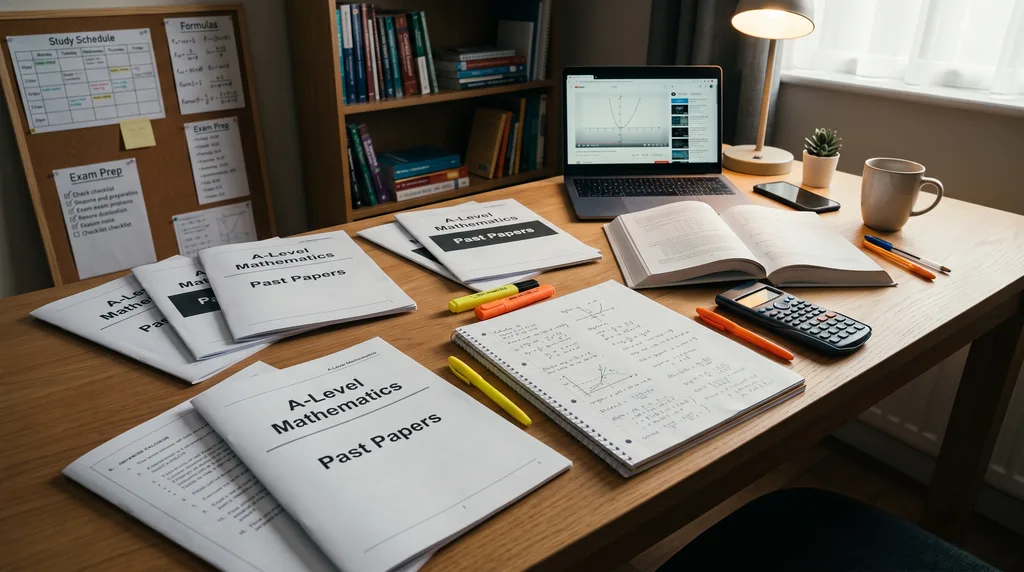
Once you have revised the major topics, start attempting complete A Level Mathematics past papers under realistic examination conditions.
Follow these steps:
- Choose a suitable paper for your syllabus and examination component.
- Set a timer according to the official examination duration.
- Work independently without checking notes or solutions.
- Show your mathematical working clearly.
- Avoid using a calculator unless it is permitted for that examination.
- Leave difficult questions temporarily if you are stuck, then return to them when possible.
- Stop when your allotted time ends.
After finishing, use the corresponding mark scheme to assess your answers.
Do not worry if your first attempt is weaker than expected. The purpose of practice is to identify what you need to improve before the real examination.
Step 5: Use Mark Schemes to Learn from Mistakes
Checking only your final score will not tell you why you lost marks.
After completing each paper, review every incorrect or incomplete answer. Compare your method with the mark scheme and identify the specific problem.
Common mistakes include:
- Applying the wrong formula.
- Making algebraic errors.
- Using an incorrect differentiation or integration method.
- Missing a required step in a calculation.
- Giving an answer without sufficient supporting working.
- Making rounding or calculator errors.
- Misinterpreting the wording of a question.
Keep a mistake log in a notebook or spreadsheet. Record the topic, the mistake, the correct method, and what you will do differently next time.
Reattempt the incorrect questions after a few days without looking at the solutions. This helps you determine whether you have genuinely understood the method.
Step 6: Create a Weekly Mathematics Revision Plan
Consistency is more effective than leaving all your preparation until the final days before an examination.
A simple weekly timetable can help you balance topic revision, practice questions, and full papers.
| Day | Revision activity |
|---|---|
| Monday | Revise one difficult topic and solve examples |
| Tuesday | Practise topic-based examination questions |
| Wednesday | Review another topic and correct previous mistakes |
| Thursday | Attempt a timed section of a past paper |
| Friday | Check answers and update your mistake log |
| Saturday | Attempt a full paper when you are ready |
| Sunday | Review weak areas and plan the next week |
Adjust this timetable to match your school schedule, examination date, and other subjects.
As your examination approaches, increase timed practice while continuing to revise topics where your performance is weak.
Step 7: Improve Your Mathematical Working
In Mathematics, reaching the correct final answer is not the only part of effective exam technique.
Your working should be clear, logical, and easy to follow. Write down the main steps in your method, keep calculations organised, and check whether your answer is reasonable.
For example, when solving a differentiation question, show the derivative, use it appropriately in the next step, and present the final result clearly.
Practising with A Level Mathematics past papers helps you develop a consistent approach to presenting solutions.
Always follow the instructions on the question paper and the relevant examination rules. Do not assume that an unsupported answer will receive the same marks as a clearly demonstrated method.
Common Mistakes Students Should Avoid
Even hardworking students can lose marks because of avoidable preparation mistakes.
Memorising without understanding: Learn why a formula works and when to apply it instead of memorising it without context.
Practising only easy questions: Gradually introduce more challenging questions so you can develop stronger problem-solving skills.
Ignoring mark schemes: Use them to understand expected methods and identify gaps in your working.
Repeating the same mistakes: Keep a mistake log and revisit incorrect questions until you can solve them independently.
Using outdated materials without checking: Compare older papers with your current syllabus and examination requirements.
Studying without a timetable: Set realistic weekly goals and review your progress regularly.
Leaving timed practice until the end: Build examination timing into your preparation well before the examination date.
How Can Khadija Online Academy Help A Level Mathematics Students?
Students sometimes need additional support when independent revision is not enough. A teacher can explain difficult concepts, demonstrate alternative methods, and help students understand why their answers are incorrect.
At Khadija Online Academy, students can explore available online learning support for Cambridge subjects, revise challenging topics, and strengthen their understanding through guided learning.
If you need help with Pure Mathematics or another component of your course, explore the relevant courses and learning resources available through our website.
Combine guided learning with regular independent practice. This gives you an opportunity to understand concepts and apply them to unfamiliar examination questions.
Frequently Asked Questions
1. Where can I find A Level Mathematics past papers?
You can start with the official Cambridge International Mathematics 9709 past papers page. Check the available question papers, specimen papers, and mark schemes against your syllabus and examination component.
2. How many past papers should I solve before my exam?
There is no fixed number that guarantees success. Focus on practising consistently, understanding your mistakes, and improving your performance. Solving fewer papers carefully can be more useful than completing many papers without reviewing your errors.
3. Should I solve past papers topic by topic or as full papers?
Use both approaches. Topic-based questions help you strengthen individual skills, while full papers help you practise time management and apply different methods in one examination.
4. Are older Cambridge Mathematics papers useful?
Yes, they can provide additional practice. However, check the current syllabus first because older question papers may contain topics or assessment requirements that differ from your course.
5. How can I improve my A Level Mathematics exam performance?
Revise the syllabus, practise questions regularly, use mark schemes carefully, maintain a mistake log, and complete timed papers. Seek help with topics you repeatedly find difficult.
6. Is the 9709 syllabus the same for every A Level Mathematics student?
Not necessarily. The syllabus offers different combinations of Pure Mathematics and applied components. Check your selected route, syllabus year, and examination entries to ensure that you practise the correct papers.
Final Thoughts
Success in Cambridge Mathematics depends on understanding concepts, practising suitable questions, learning from mistakes, and managing your examination time effectively.
A Level Mathematics past papers should be an important part of your revision plan, but they work best when combined with syllabus-based study, topic practice, and careful review of mark schemes.
Start with the topics you find most difficult, set achievable weekly goals, and track your progress. With consistent effort and a structured preparation strategy, you can approach your examinations with greater confidence and a clearer understanding of what you need to improve.
Explore the relevant Cambridge Mathematics resources and learning support available through Khadija Online Academy to continue strengthening your preparation.