
Free AI Math Solver: Solve Math Problems Step by Step
Mathematics can be difficult when you are trying to understand equations, formulas, algebra, or calculus. Sometimes, you know the formula but do not understand how to apply it to a question. Other times, you get an answer but are unsure whether your calculations are correct.
A Free AI Math Solver can help make learning mathematics easier by explaining problems step by step. Instead of showing only the final answer, an AI-powered math tool can help students understand the method, review important formulas, and learn how to solve similar questions independently.
Whether you are studying IGCSE, O Level, A Level, or another mathematics course, an AI math solver can be a useful addition to your study routine. In this guide, you will learn how these tools work, which problems they can help with, and how to use them effectively.
What Is a Free AI Math Solver?
A Free AI Math Solver is an online tool that helps users solve mathematical problems with the assistance of artificial intelligence or mathematical computing technology.
Depending on its features, a tool may allow you to type a question, enter an equation, or upload an image of a maths problem. It then processes the question and provides a result, an explanation, or both.
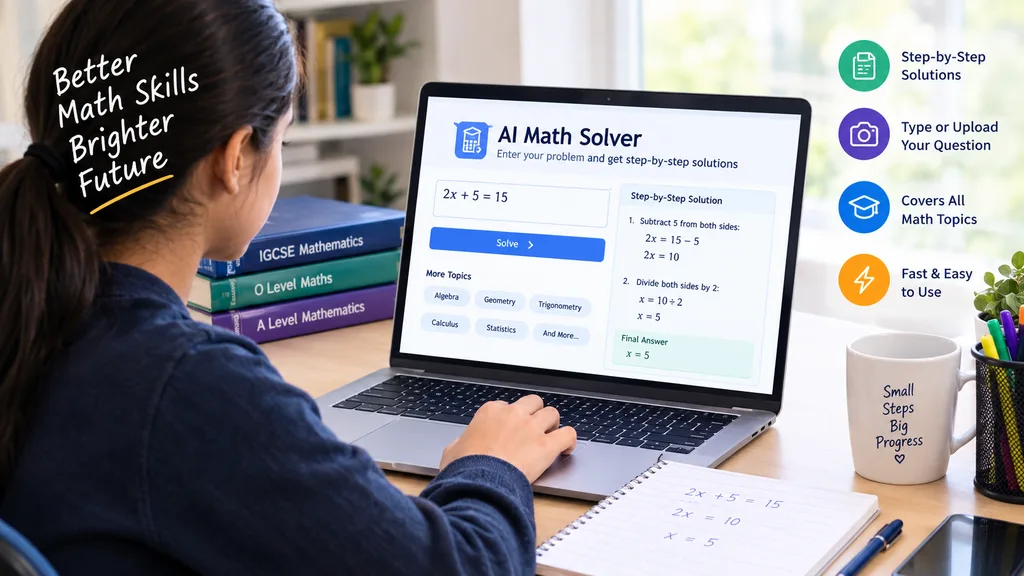
For example, suppose you are trying to solve this equation:
2x + 5 = 15
The solution involves subtracting 5 from both sides and then dividing by 2.
- Start with: 2x + 5 = 15
- Subtract 5 from both sides: 2x = 10
- Divide both sides by 2: x = 5
A good AI math solver should help you understand why these steps work, not simply tell you that the answer is 5.
Table of Contents
How Does an AI Math Solver Work?
AI math tools use different technologies to understand questions and generate solutions. The exact process depends on the tool and the type of mathematical problem.
Here is how a typical tool works:
Step 1: Enter Your Maths Question
Type the question into the input box. Some tools also support image uploads, allowing you to submit a question from a textbook, worksheet, or practice paper.
Step 2: Let the Tool Process the Problem
The system identifies the mathematical expressions, numbers, symbols, and instructions in your question. Depending on the technology used, it may apply mathematical computation, AI reasoning, or a combination of methods.
Step 3: Review the Solution
The tool generates an answer and may explain the calculations in several steps. This can help you understand which formula or mathematical rule is being used.
Step 4: Practise the Method Yourself
Once you understand the explanation, try solving a similar question without assistance. This is an important step because understanding a worked example does not always mean you can solve the next problem independently.
What Types of Maths Problems Can an AI Math Solver Solve?
The supported topics depend on the tool. Many mathematics-solving platforms provide assistance with several common areas.
1. Basic Mathematics
Basic mathematics includes addition, subtraction, multiplication, division, fractions, decimals, percentages, and ratios.
For example, an AI tool may help you calculate a percentage or explain how to simplify a fraction.
2. Algebra
Algebra uses letters and symbols to represent unknown values. Students often need help simplifying expressions, solving equations, and understanding quadratic functions.
An AI math solver can show the working process for supported algebra questions and explain how to isolate an unknown variable.
3. Geometry
Geometry focuses on shapes, angles, distances, areas, and volumes. Depending on the tool, you may receive help with formulas and calculations involving triangles, circles, and other geometric figures.
Always check whether a question requires a diagram or additional information that the tool may not have interpreted correctly.
4. Trigonometry
Trigonometry involves relationships between angles and sides of triangles, as well as trigonometric functions such as sine, cosine, and tangent.
Students can use AI assistance to review formulas and understand selected trigonometry problems.
5. Calculus
Calculus includes topics such as differentiation and integration, which are particularly important in many A Level Mathematics courses.
An AI tool may help explain derivatives, integration rules, and intermediate calculations. Students should still learn the relevant mathematical rules and practise questions from their own syllabus.
6. Statistics and Probability
Statistics and probability involve analysing data, calculating probabilities, and interpreting numerical information.
Some tools can assist with averages, probability questions, and statistical calculations. Available features vary, so check whether your chosen tool supports the specific topic.
Why Should Students Use a Free AI Math Solver?
Understand Difficult Questions
When a textbook explanation is confusing, an alternative step-by-step explanation may help you understand the same concept from a different perspective.
Save Time During Revision
Students can use an AI math solver to review calculations, check selected answers, and revisit difficult topics during revision. However, the time saved should be used for more practice rather than avoiding it.
Learn From Mistakes
Comparing your own working with a generated solution can help you identify errors, such as using the wrong formula or making a sign mistake.
Study at Your Own Pace
You can revisit an explanation whenever you need it. This is particularly helpful when you are studying independently and want to review a topic before asking your teacher for further guidance.
Prepare for Examinations
For Cambridge students, an AI math solver can supplement past-paper practice. It can help explain a difficult question after you have attempted it yourself.
You can also explore our [IGCSE Maths Past Papers guide — REPLACE_WITH_KHADIJA_MATHS_BLOG_URL] to learn how past papers can support your revision.
How to Use a Free AI Math Solver Effectively
Getting an answer is easy, but learning the method requires active practice. Follow these tips to get more value from an AI-powered mathematics tool.
1. Enter the complete question. Include all numbers, symbols, brackets, and instructions. Incomplete information can lead to incorrect results.
2. Ask for a simple explanation. If you are a beginner, request a solution that explains each step in easy language.
3. Understand the formula. Identify the rule used to solve the problem. Do not memorise steps without understanding why they work.
4. Check the result. Substitute your answer into the original equation where appropriate, or verify the calculation using a trusted mathematical resource.
5. Try another question. Solve a similar problem without looking at the answer. This will help you determine whether you have understood the concept.
6. Use your syllabus as a guide. If you are preparing for IGCSE, O Level, or A Level examinations, practise questions that match your syllabus and examination requirements.
For additional mathematics lessons and practice, visit Khan Academy Mathematics.
Free AI Math Solver vs Traditional Learning
AI tools and traditional learning resources can work together. Neither approach needs to replace the other.
| Feature | AI Math Solver | Traditional Learning |
|---|---|---|
| Quick help | Can provide rapid assistance | Depends on the resource or teacher |
| Worked solutions | Available in supported tools | Textbooks often provide worked examples |
| Personal guidance | Depends on the tool | Teachers can respond to individual learning needs |
| Exam preparation | Helps review selected questions | Provides structured syllabus-based preparation |
| Independent learning | Useful for checking methods | Builds knowledge through reading and practice |
For the best results, use AI to clarify difficult concepts and use your teacher, textbook, and past papers to build a strong understanding of mathematics.
Can You Trust AI Math Solver Answers?
AI math solvers can make mistakes. A question may be misunderstood, a calculation may be incorrect, or the explanation may skip an important step.
For this reason, always check important answers. Compare the solution with your textbook, review the relevant formula, and ask your teacher if you remain uncertain.
You should also avoid relying on AI during an examination if the examination rules do not permit its use. Follow your school’s academic integrity requirements and use AI responsibly during revision.
Introducing Our AI Math Solver Project
We are developing an AI-powered mathematics-solving tool designed to make mathematical practice easier and more accessible for students.
[FREE AI Math Solver Tool]
The goal is to help learners explore mathematical problems, understand solution methods, and improve their confidence through guided practice. Once the tool is available, this section can explain its actual features, supported topics, and instructions for using it.
For more educational resources, visit Khadija Online Academy. Students can explore study guides and revision resources to support their Cambridge learning journey.
You can also visit Waqas Mehmood — Digital Projects and Resources for related educational technology projects and learning tools.
Frequently Asked Questions
Is a Free AI Math Solver really free?
Some tools provide free access to selected features, while others may limit the number of questions, image uploads, or advanced solutions. Check the pricing and usage limits of the specific tool before using it.
Can an AI math solver explain answers step by step?
Some tools provide detailed explanations, while others focus mainly on final answers. Choose a tool that offers understandable working if your goal is to learn mathematics.
Can I use an AI math solver for IGCSE and A Level Mathematics?
AI tools can assist with many topics studied at these levels, including algebra, trigonometry, differentiation, and statistics. However, the tool may not cover every syllabus requirement, so continue using official syllabus materials and past papers.
Can an AI math solver make mistakes?
Yes. AI tools may misinterpret a question or generate an incorrect answer. Always check important results and make sure you understand the mathematical method.
Does using an AI math solver help me learn mathematics?
It can help when you study the explanation, identify the relevant rule, and practise similar questions independently. Simply copying answers is unlikely to develop strong problem-solving skills.
Conclusion
A Free AI Math Solver can be a helpful learning resource for students who want to understand equations, review mathematical rules, and practise challenging problems. Its value comes from explaining the method and supporting independent learning, rather than providing answers without understanding.
Combine AI-assisted practice with textbooks, past papers, and teacher guidance to build stronger mathematics skills. As our own AI math-solving project develops, this guide will provide a place to introduce its features and help students understand how to use it effectively.