
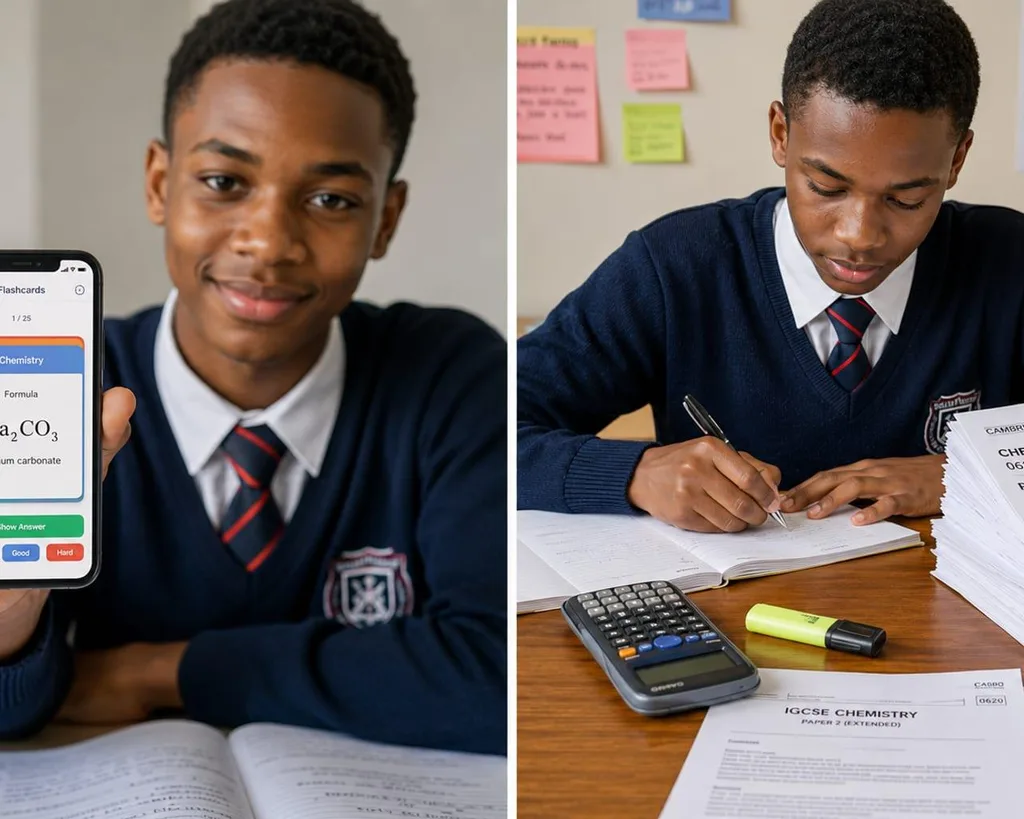
Preparing for IGCSE Chemistry exams can feel challenging, especially when students are unsure about the types of questions they may face. One of the most effective ways to understand the exam format and improve preparation is by using IGCSE Chemistry Past Papers.
Past papers allow students to practise real exam-style questions, identify common question patterns, improve time management, and understand how marks are awarded. However, simply solving paper after paper is not enough. Students need to use past papers as part of a structured study strategy.
In this guide, we will explain how to use IGCSE Chemistry past papers effectively and turn mistakes into opportunities for improvement.
Table of Contents
What Are IGCSE Chemistry Past Papers?
IGCSE Chemistry past papers are previous examination papers designed according to the relevant IGCSE Chemistry syllabus and assessment structure. They give students an opportunity to practise questions similar to those used in actual examinations.
Depending on the examination board and syllabus, students may find different types of questions covering areas such as atomic structure, bonding, stoichiometry, acids and bases, chemical reactions, organic chemistry, and practical skills.
Students should always make sure that the past paper matches their current syllabus, examination board and paper type.
Why Are IGCSE Chemistry Past Papers Important?
Past papers are useful because they turn theoretical knowledge into exam practice.
Understand the Exam Format
Reading a textbook can help you understand Chemistry concepts, but an examination requires you to apply that knowledge. Past papers show how questions are presented and how different topics can be tested.
Identify Frequently Tested Skills
Students may notice that certain Chemistry skills appear in different forms across examination papers. Practising these questions helps students become more comfortable with calculations, explanations, equations, data interpretation and practical-based questions.
Build Confidence
The first few past papers may seem difficult. With regular practice, students become more familiar with the wording and structure of examination questions.
Confidence comes from knowing what to do when you see a question—not simply from reading notes repeatedly.
If you think you need to learn about IGCSE Physcis Past Papers here are more details.
When Should You Start Using Past Papers?
There is no need to wait until the final weeks before the examination.
Students can start using selected past-paper questions while studying individual topics. For example, after completing a topic such as acids and bases, practise relevant questions before moving to the next topic.
Once most of the syllabus has been covered, students can begin completing full papers under timed conditions.
A useful approach is:
Learn → Practise → Check → Correct → Repeat
This makes past papers part of the learning process rather than simply a final test.
How to Use IGCSE Chemistry Past Papers Effectively
The quality of your practice matters more than the number of papers you complete.
Step 1: Attempt the Paper Without Looking at the Answers
Try to answer the questions independently. Avoid checking the mark scheme after every question because this can prevent you from identifying what you genuinely know.
Step 2: Check Your Answers Carefully
After completing the paper, compare your answers with the official mark scheme where available.
Do not only count your marks. Look at why an answer received or lost marks.
Step 3: Record Your Mistakes
Create a simple mistake log.
For example:
| Topic | Mistake | Why It Happened | Correct Approach |
|---|---|---|---|
| Stoichiometry | Calculation error | Formula not applied correctly | Write the equation and calculate step by step |
| Bonding | Incomplete explanation | Key term missing | Review bonding concepts |
| Acids & Bases | Incorrect pH reasoning | Concept not fully understood | Revise pH and indicators |
This helps you identify weaknesses instead of repeatedly making the same mistakes.
Focus on Your Mistakes
One of the biggest benefits of IGCSE Chemistry Past Papers is that they can reveal exactly where your preparation needs improvement.
If you repeatedly lose marks in calculations, spend additional time practising calculations.
If you struggle with chemical equations, revise balancing and practise writing equations.
If longer explanation questions cause problems, pay attention to the scientific keywords expected in mark schemes.
Your mistakes can become a personal revision guide.
Practise Different Chemistry Topics
Do not focus only on the topics you enjoy.
Your preparation should cover the full syllabus and include different question styles.
Important areas may include:
- Atomic structure
- Elements and the periodic table
- Chemical bonding
- Stoichiometry
- Acids, bases and salts
- Electricity and chemistry
- Rates of reaction
- Energetics
- Organic chemistry
- Chemical analysis
- Practical and experimental skills
The exact content depends on your IGCSE Chemistry syllabus, so always use your official syllabus as the main checklist.
Improve Your Exam Timing
Knowing the Chemistry content is important, but managing time during the examination is also a skill.
When practising a full paper, use a timer and try to complete the paper within the official examination time.
If you spend too long on one question, practise moving forward and returning to difficult questions later.
Timed practice can gradually make the real examination environment feel more familiar.
Use Mark Schemes Correctly
A mark scheme is more than an answer sheet.
Use it to understand:
- Which points earn marks
- Which scientific terms are important
- How calculations should be presented
- What level of explanation is expected
- Where your answer was incomplete
However, students should not try to memorise every mark-scheme sentence. The goal is to understand the Chemistry concept and learn how to communicate it accurately.
Create a Past Paper Revision Plan
A simple revision plan can make past-paper practice much more effective.
For example:
Monday: Revise one Chemistry topic
Tuesday: Practise topic-based questions
Wednesday: Review mistakes
Thursday: Practise another topic
Friday: Complete selected past-paper questions
Weekend: Attempt a full timed paper and analyse mistakes
You can adjust this plan according to your school timetable, syllabus progress and examination date.
The important thing is to practise consistently rather than completing many papers in a single day and then stopping.
Final Tips for IGCSE Chemistry Preparation
Before your Chemistry examination, keep these points in mind:
- Understand the syllabus before starting revision.
- Use past papers regularly rather than only at the end.
- Practise calculations step by step.
- Learn important Chemistry terminology.
- Review every mistake.
- Use mark schemes to understand marking requirements.
- Practise under timed conditions.
- Do not ignore practical and experimental questions.
- Revise weak topics more frequently.
- Keep your revision consistent.
Remember that past papers work best when combined with proper understanding of the Chemistry concepts.
Frequently Asked Questions
How many IGCSE Chemistry past papers should I practise?
There is no fixed number that works for every student. Focus on completing enough papers to understand the exam format, identify weaknesses and improve your performance. Quality analysis of mistakes is more valuable than simply completing a large number of papers.
When should I start solving IGCSE Chemistry past papers?
You can start with topic-based questions while learning the syllabus. Once you have covered most of the syllabus, begin completing full papers under timed conditions.
Are past papers enough to prepare for IGCSE Chemistry?
No. Past papers are an important part of revision, but students should also understand the syllabus, study Chemistry concepts, practise calculations, review practical skills and use appropriate study resources.
Should I check the mark scheme after every question?
It is generally more useful to complete a section or full paper first and then review the mark scheme. This gives you a better idea of what you can answer independently.
How can I improve my Chemistry marks using past papers?
Keep a record of your mistakes, identify repeated weak areas and revise those topics before attempting similar questions again. This turns past-paper practice into targeted revision.
Conclusion
IGCSE Chemistry Past Papers can be a powerful revision tool when they are used strategically. They help students become familiar with examination questions, practise applying Chemistry concepts, improve time management and identify areas that need more attention.
Instead of simply trying to complete as many papers as possible, focus on understanding your mistakes and improving after every practice session.
With consistent revision, topic-based practice and timed examination practice, students can approach their IGCSE Chemistry preparation with greater confidence and a clearer study strategy.
Khadija Online Academy supports students with structured learning and guidance for O Level and A Level subjects. For students preparing for Cambridge examinations, combining classroom learning with focused practice can make revision more organised and productive.
Pingback: SEO Title: IGCSE Maths Past Papers: A Complete Guide for Students